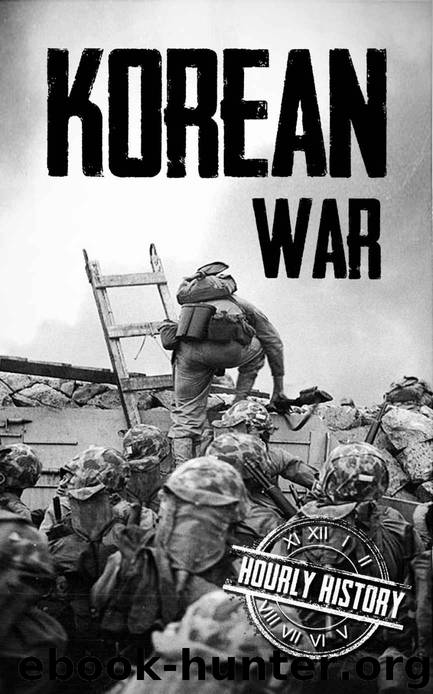
Korean War: A History From Beginning to End by History Hourly
Author:History, Hourly [History, Hourly]
Language: eng
Format: epub
Publisher: Hourly History
Published: 2017-01-01T05:00:00+00:00
Chapter Six
Stalemate at the 38th Parallel
“Of the nations of the world, Korea alone, up to now, is the sole one which has risked its all against communism. The magnificence of the courage and fortitude of the Korean people defies description.”
—General Douglas MacArthur
The Korean War was a war of attrition: both sides marked victory by gaining or maintaining territory. Therefore, after the victories at Inchon and Seoul, it was imperative that the UN forces keep pushing. Thus began the UN Offensive in the Korean War.
A strategic question loomed over United States leadership: whether or not to pursue the North Koreans north of the 38th parallel, the line that had divided North and South Korea, and the line the North Koreans crossed when they started the war. A major concern was whether crossing this line would prompt the Soviet Union or the Chinese to intervene; the United States did not want a long, protracted war with another major world power. Truman authorized MacArthur to cross, but only if there was no presence of other powers in Korea.
Just three days after issuing that warning to MacArthur, on September 30, Truman’s Secretary of Defense, George Marshall, authorized MacArthur to pursue the North Koreans back into their own territory. The very next day, MacArthur crossed the 38th parallel.
In response, on October 1, the Chinese officially entered the war. They did so in response to what they perceived as aggression on the part of the United States and the United Nations. They also did so in response to appeals from Kim Il-sung, and with permission from Stalin, though not without resistance from some Chinese leaders. Nonetheless, the Chinese entered the war officially on October 8. Troops arrived in Korea on October 25, after the Chinese had secured a commitment from Stalin that he would send some supplies to support the offensive.
Fighting thus continued between the United States/United Nations/South Koreans and North Koreans and Chinese. That it continued to be a war of attrition meant that the goal of the battles was capturing cities and more terrain.
The Chinese army was very well-trained and well-disciplined. The UN forces were not even sure that they had intervened in the war: they moved only at night and were very well camouflaged. Later, after the Chinese had engaged UN forces and quickly retreated, UN and U.S. leadership wondered whether they had left the war. They had not, however. The two sides were fairly well matched, which meant that the war was starting to drag out, despite the United States’ and MacArthur’s “Home by Christmas” offensive and the resulting Battle of the Ch’ongch’on River, which began on November 25 and lasted until December 2 in north-western North Korea (near the Chinese border).
This battle was primarily between the Chinese 13th Army and the United States Eighth Army. Chinese strategic positions caused very heavy losses on U.S. and United Nations forces, forcing a retreat; this time, the Chinese gave chase back to the 38th parallel. The Eighth Army’s forces were so badly weakened that other U.
Download
This site does not store any files on its server. We only index and link to content provided by other sites. Please contact the content providers to delete copyright contents if any and email us, we'll remove relevant links or contents immediately.
| Africa | Americas |
| Arctic & Antarctica | Asia |
| Australia & Oceania | Europe |
| Middle East | Russia |
| United States | World |
| Ancient Civilizations | Military |
| Historical Study & Educational Resources |
The Sympathizer by Viet Thanh Nguyen(4450)
The Rape of Nanking by Iris Chang(4267)
World without end by Ken Follett(3512)
Ants Among Elephants by Sujatha Gidla(3496)
Blood and Sand by Alex Von Tunzelmann(3243)
Japanese Design by Patricia J. Graham(3220)
The Queen of Nothing by Holly Black(2661)
City of Djinns: a year in Delhi by William Dalrymple(2582)
India's Ancient Past by R.S. Sharma(2493)
Foreign Devils on the Silk Road: The Search for the Lost Treasures of Central Asia by Peter Hopkirk(2482)
Tokyo by Rob Goss(2472)
Inglorious Empire by Shashi Tharoor(2465)
In Order to Live: A North Korean Girl's Journey to Freedom by Yeonmi Park(2411)
Tokyo Geek's Guide: Manga, Anime, Gaming, Cosplay, Toys, Idols & More - The Ultimate Guide to Japan's Otaku Culture by Simone Gianni(2400)
India's biggest cover-up by Dhar Anuj(2382)
The Great Game: On Secret Service in High Asia by Peter Hopkirk(2375)
Goodbye Madame Butterfly(2289)
Batik by Rudolf Smend(2214)
Living Silence in Burma by Christina Fink(2094)
